Dead or Dying Trees
A dead tree loses structural integrity quickly. Bark falls away, wood becomes brittle, and root anchoring fails — often without visible warning. Dead trees near structures should be removed promptly.
Safe, controlled removal of dead, diseased, and hazardous trees — protecting your home, lawn, and landscaping throughout the process. ISA-certified crews serving all of Northern Virginia.
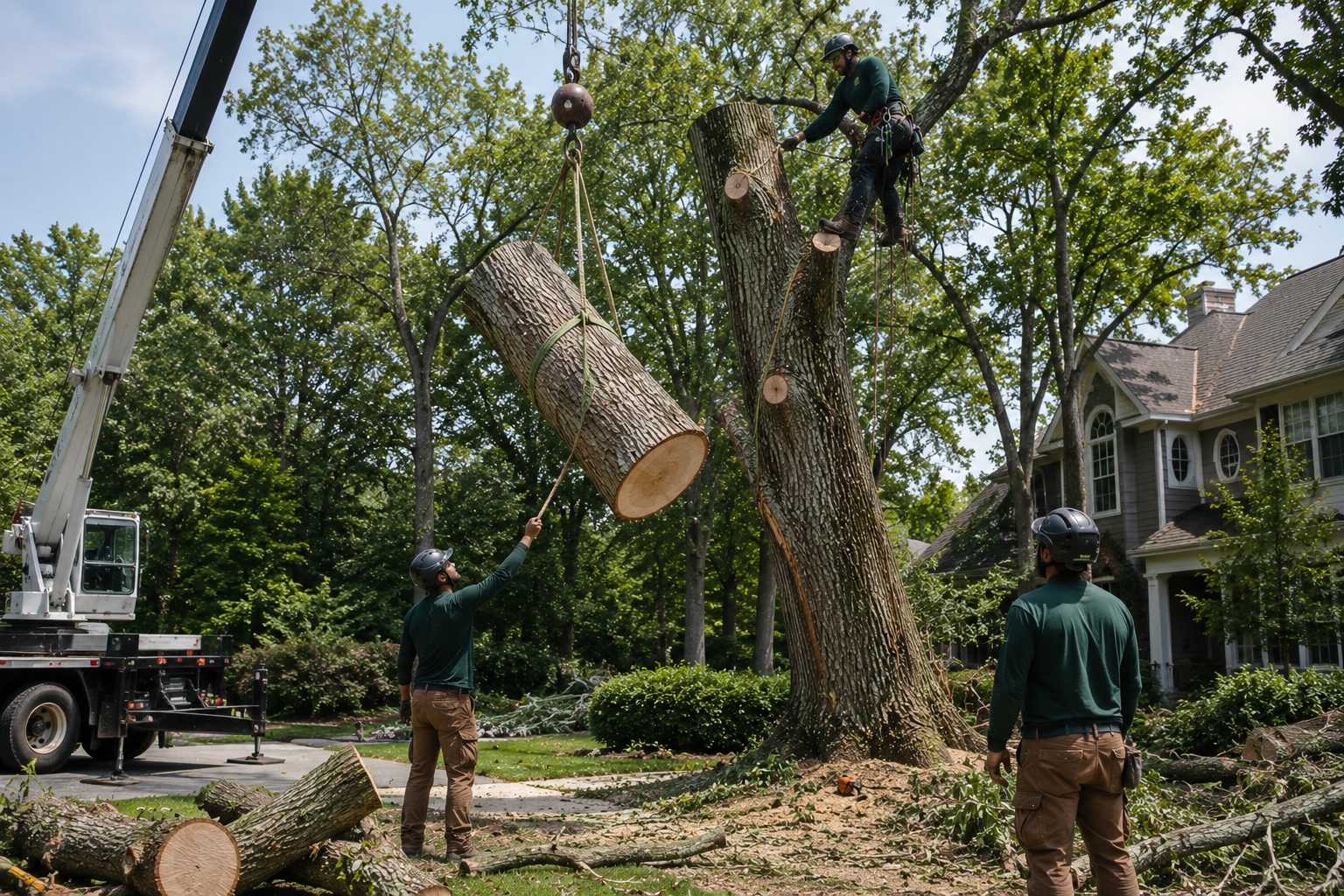
Tree removal is one of the highest-risk jobs in the landscape industry — and the difference between a crew that knows what they're doing and one that doesn't is the difference between a clean job and a hole in your roof. At NoVA Tree Trimming, every removal is planned in detail before a single cut is made.
Our ISA-certified arborists assess the tree's lean, weight distribution, root condition, and proximity to structures before determining the removal method. For trees near homes, fences, or power lines, we use sectional takedowns with rigging — lowering each piece in a controlled sequence rather than felling the whole tree at once. Your lawn, landscaping, and structures are protected throughout.
We also handle permit research for jurisdictions that require removal permits (Arlington, Alexandria, and parts of Fairfax County all have tree ordinances). We'll tell you upfront if a permit is needed and what's involved.
Every tree removal includes a full pre-job site assessment, sectional removal or full fell as appropriate, stump cut to ground level, complete debris cleanup, and a post-job walkthrough. We haul every log, branch, and chip off your property unless you want to keep the wood.
We evaluate the tree's condition, size, lean, and proximity to structures. We check permit requirements for your jurisdiction and provide a written estimate.
If your municipality requires a tree removal permit, we'll identify what's needed and advise on the process. Permit fees, where required, are the homeowner's responsibility but we guide you through it.
For trees near structures, our climbers rig and lower each section in sequence. For trees with open fall zones, we fell the tree whole. Property protection is laid before we begin.
We cut the stump as close to ground level as our equipment allows. If you want full stump elimination, ask about our stump grinding service — we offer a discount when bundled with removal.
All debris is chipped and hauled, or left as firewood logs if you prefer. We rake and blow the area clean, then walk the property with you before we leave.
Not every struggling tree needs removal — our arborists will always tell you honestly whether a tree can be saved. But these situations typically call for removal.
A dead tree loses structural integrity quickly. Bark falls away, wood becomes brittle, and root anchoring fails — often without visible warning. Dead trees near structures should be removed promptly.
Oak wilt, fire blight, and Armillaria root rot can kill trees from the inside out. When disease reaches the root system or vascular tissue, removal is often the only way to prevent spread to neighboring trees.
Co-dominant stems with included bark, large cracks running through major limbs, hollow trunks, or significant lean all indicate failure risk. An ISA-certified arborist can evaluate whether the risk is manageable.
EAB has killed tens of millions of ash trees in the eastern US. Once infestation is advanced, treatment is ineffective. Ash trees showing S-shaped galleries, D-shaped exit holes, or dieback above 50% typically need removal.
Trees that have grown into or over rooflines, foundations, or power lines often can't be pruned to a safe condition. In these cases, removal is safer and more cost-effective than years of reactive pruning.
Major split trunks, uprooted root plates, or large sections of crown failure from storms often leave the remaining tree structurally unsound. We assess whether repair or removal is the right path.
Tree removal near homes and landscaping requires careful planning. Here's how we protect what matters to you.
For trees near structures, each section is rigged with ropes and lowered in a controlled sequence — never dropped.
We lay ground protection before equipment moves in. Heavy machinery is kept off lawn where possible; when not, we mitigate compaction.
Every job near a structure is mapped in advance. We identify drop zones, rope paths, and crew positions before work begins.
We carry $2M in general liability insurance and full workers' compensation on every crew member. Ask for our certificate before any work starts.
We chip all brush, haul all debris, rake and blow the area, and restore your property to better condition than we found it.
Several NoVA jurisdictions regulate the removal of significant trees — particularly large-diameter specimens or trees in protected areas. Arlington County, Alexandria, and parts of Fairfax County all have tree protection ordinances that may require a permit before removal.
We research permit requirements for every job as part of our free estimate process. If a permit is needed, we'll tell you exactly what's required and what the timeline looks like. Permit fees, where required, are typically modest ($25–$100) and paid by the homeowner.
Free estimate · Written proposal · No obligation
Tell us about the tree you need removed and we'll follow up within one business day with a free written estimate. No pressure, no obligation.
Tree Removal Estimate Request
Usually responded to within 24 hours · No obligation
We'll follow up within one business day. Or call us now at (571) 555-0190.